Showing posts with label Horror. Show all posts

Saturday, April 11, 2009

10. Twilight

Meyer, Stephenie. Read by Ilyana Kadushin. Twilight. Little Brown and Company: New York, 2005.

Annotation: Clumsy Bella is the new girl in town and has her eye on Edward. There's just one problem, he's a vampire.

Justification for Nomination: This was my first time listening to a book instead of reading it. I will admit that it was sort of relaxing and a new experience but I didn't seem to get as much out of the "Twilight" audio CD than I probably would have reading it.

One thing I noticed with this story was the massive amounts of descriptions and building sexual attraction our heroin Bella has toward Edward. I didn't mind all the description but there was something just "off" about the way things were pronounced by narrator Ilyana Kadushin. I tried with all my might to be open to this new experience but I could never fully become comfortable with the audio and no visual.

I struggled to get through the audio book because I found too many distractions around me. It would have been great if I was a good multi-tasker or kept myself busy while listening, but for a twenty five year old film student I was too antsy. I was waiting to hear the books speaking parts acted out with more intensity or flare. I'm so used to my own visualisations that the experience felt like I had lost one of my major senses. Instead all of the female parts came off tedious and droning. I definitely thought they could have used a younger narrator.

As for the books overall plot points and storyline, I was incredibly intrigued. I'm no stranger to vampire genre and will be the first to admit my interest in its mythology. I grew up an avid fan of "Buffy the Vampire Slayer," and of the film version of Anne Rice's "Interview With the Vampire." Like most YA readers I have an incredible hunger for all of its interpretations. I found Stephenie Meyers own vision distinct and mysterious. She definitely has a skill for keeping the reader (or in my case, listener) intrigued.

A negative critique I had towards the overall story was the lengthy descriptions that dragged a chapter or scene out. I think she has a knack for beautiful descriptions and capturing the "angsty" teenager, but at times it became too much. Maybe I only realized it because I was listening and not reading. Perhaps its an entirely different experience reading the text but the audio CD became too long.

Overall the characters were fully developed and I could see the pull of YA readers toward each one. I found it interesting how Meyer's incorporates mystery, horror and romance but sometimes each portion either came on too strong or not enough.

It took a while to get through some of the set up and reach the climax of the book, but once I was there I was completely satisfied and thirsting for more.

Sunday, March 29, 2009

8. Scary Stories to Tell in the Dark


Schwartz, Alvin and Stephen Gammell. Scary Stories to Tell in the Dark. Scholastic Inc: New york, 1981.

Annotation: Alvin Schwartz's retelling of classic urban legends and folklore will chill and thrill readers of all ages.

Justification For Nomination: I've voiced my personal attraction to horror in blogs before, so it was only natural to be drawn to this collection of classic Folklore. Alvin Schwartz's collection of "Scary Stories," is a book I remember that never made it into my private Lutheran middle school library, or high school for that matter. There were a lot of horror related books such as "Goosebumps," "Fear Street," or anything by Christopher Pike that I was curious to read but wasn't allowed access too. Perhaps that's why I find them and the horror genre fascinating today.

At a young age, I didn't dare challenge authorities or the rules but a fellow rebellious classmate named Melissa did. She seemed to have a certain curiosity for all the things teachers outlawed which compelled her to check "Scary Stories to Tell in the Dark" out at the public library. I remember her showing it to other classmates during recess when the teachers weren't around, but I refused to read it. She always had books that weren't "school appropriate" and would secretly smuggle them to other classmates.

It wasn't until this lecture and viewing the ALA's banned/challenged books list that I was reminded of Alvin Schwartz's terrifying tales collection. Of course, as an adult I don't find the stories at all shocking, but to a young reader I could see the nature of the stories too terrifying.

The book is broken down into five chapters. Before entering each chapter there is a two sentence description informing the reader, of the authors purpose. The first chapter includes a story with directions to give your listeners a good "jump scare." The second includes classic ghost stories. The third chapter focuses on various horrors such as witches, corpses and all things scary. Chapter four are moral scary stories that warn you of real life dangers. The last chapter focuses on the dark material that is supposed to make you laugh in the end. Overall the author doesn't hide the danger, horror and violence from these tales which could really tick off a concerned parent.

Even though each story has a violent or terrifying ending, I didn't read anything particularly offensive. I would definitely suggest this book for older readers, but the most terrifying thing about the stories are the black and white sketches included. Illustrator Stephen Gammell has extremely gruesome and disturbing interpretations of each story. Thinking back to those middle school days it wasn't the text I remember most, but the images I quickly viewed as a child that gave me nightmares. If it weren't for the illustrations I can't say the book would be any better or worse but it might cut back some of a YA readers fear.

Since there weren't any central characters or extended plots it's hard to review the book for its story telling device. The thing I most highly claim with this book is its brutal honesty. Alvin Schwartz must have known what demographic he was aiming but didn't keep details from the reader. I respect that he put this information out and managed to keep the stories violent and scary while molding it into his own image. The information wasn't too over the top and filled with blood and guts. It was simplistic and just scary enough to become a cult novel (like it had in my middle school.) "Scary Stories" is filled with hands on activities, jokes and songs to thrill the YA reader instead of scaring them to death, like some films do.

While I highly recommend this book, I also see why parents may ban this from their kids readings list. This story does deal with graphic material but by preventing a reader from reading it may only provoke them to getting it themselves in the end.

Saturday, March 7, 2009

6. The Babysitter


Stine, R.L. The Babysitter. Scholastic Inc: New York, 1989.
Annotation: Jenny's always hesitated taking on her new babysitting job, but combined with her paranoia and one too many suspicious phone calls the terror has just begun.
Justification for Nomination: Being an avid fan of suspense and having a particular love for horror "The Babysitter" by R.L Stine took a classic fright of a defenseless babysitter and pitted it against a drafty house, a manic stalker, and loads of suspense.
One thing I've always respected about R.L Stine is that fact that the man sometimes lifts certain stories/plots that we've all heard before and adds his own supernatural or suspenseful plot line to make it shiny and new again. His story "The Babysitter" for example is his own creation with colorful characters and sensory surroundings but uses a plot line similar to "The Babysitter" an urban legend, about an innocent teenage babysitter harassed by menacing phone calls only to find out that they are originating from inside the house.
A film example using the same plot device is 1979's "When a Stranger Calls" released ten years before Stine's "Babysitter" and following a lonely babysitter harassed and stalked while inside an eerie house. So as you can see this plot isn't exactly fresh material but as the past has shown with its successors, it makes for a great story.
Stine's toned down violence and YA version of the story remains suspenseful without becoming explicit. As you read the details and thoughts inside Jenny (our protagonist's) over indulgent mind you start to become one with her and see or hear things that don't exist. The beauty of "The Babysitter" is that when the protagonist's paranoia sets in the reader isn't sure if what she's describing is real or is imaginary. Each chapter ends with a suspenseful mark forcing you to push on in the story and find out the truth or violent end to its means.
The only negativity I would slap with R.L Stine is that he becomes so invested in his heroin and doesn't give the reader much time to get to know anyone else. He does such a good job getting into the main characters voice and her teenage curiosities and angst that we are shown mere glimpses of the supporting cast. The beauty of all of this is that by doing so, it cast suspicion on friends and even the family that hired her for the babysitting job. Stine reveals the different arch-types such as the geeky yet cute new kid, the sexually active best friend, an overbearing father, and the dark, mysterious stranger but still manages not to make them extremely cliche.
I recommend this book because even when it's not suspenseful, we still get to follow the socially awkward and slightly paranoid protagonist struggling with a mysterious stalker on top of relationships, boys, money and the horror of gym class packed into 167 pages.
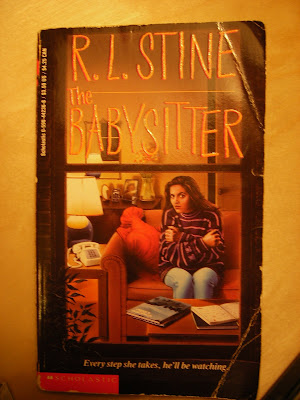
Another thing I've always loved about R.L Stine whether it be stand alone stories like "The Babysitter", "Goosebumps" or his series "Fear Street" is that he always has some of the best cover art. If you really go back and research the old cover art for his early book you will see the detailed pictures that show you just enough to jump start your imagination. The cover art for "The Babysitter," as seen above, is worth a thousand words. Not only does it give you a great visual image of Jenny's character but also shows the intensity within a scene. You can see her, but she can't seem to see you, which interplays wonderfully with the theme and plot of this story.
Though "The babysitter" focuses in on more suspense than violence another respectable fact of R.L Stine's YA novels is that he saves the best details for last. You never actually think that he'll incorporate any physical violence or deaths but it all surfaces during the climax of this story. If you've already convinced yourself not to read this story due to its familiar plot, due yourself a favor and check it out, it may surprise you.