Showing posts with label Coming of Age. Show all posts

Saturday, April 4, 2009

9. The Kite Runner


Hosseini, Khaled. The Kite Runner. Berkley Publishing Group: New York, 2003.
Annotation: Two young boys face life in Afghanistan while dealing with political turmoils, the rise of the Taliban, and a betrayal that will forever lead to regret.
Justification for Nomination: At first read, I questioned whether I had picked the right Alex award winning book because of its graphic nature. The "Kite Runner" presented itself in a gritty and raw presentation that I found hard to believe for YA readers to attach themselves to it. If anything I would have labeled this a pure adult novel due to the sexual connotations, language and descriptions.
I took myself back to my YA years (which doesn't feel that long ago) and questioned whether or not I would have even attempted a book of this magnitude. As I read on I got used to the story, characters, and conflicts. The book was like a culture shock and the further you read in the book the easier the information became.
I found the book beautifully written and narrated. As stated in the "Crossing Over" article by Angelica Beneditti I reasoned on what I would tell a younger reader and it would be similar to what she had heard when she checked out the "The World According to Garp," that you should read this book when you're older. I never assume or doubt a young readers ability to understand such gritty material, but even I can admit to reading books at an older age and realizing that there were just some things that I didn't fully understand. "The Kite Runner" is full of adult material and depending on the readers self knowledge and grade level some subject matters may either confuse them or be simply glossed over.
"Kite Runner," does a phenomenal job blurring the lines between memoir and fiction. At times you felt that the author was telling a life story because of the fine sensory details you read. The emotion from conflict flows naturally and your heart breaks into a million pieces over and over again. It's like riding a bike for the first time. You seem to fall off, or step away from the book but keep coming back to learn more.
Another great aspect of this novel is that the information presented doesn't have an agenda. I often hate when films or books push the facts around so it becomes one sided. "The Kite Runner" shows the reader a different culture and line of events that happened naturally and weren't fudged to the authors transgression.
I was pleased that even though the conflict had dark moments that I didn't automatically turn away from the story because of its unfamiliar setting. It was brilliant because it's a culture some people know little about besides whats on the news and the author wasn't afraid to take you around dark corners or through a forbidden field.
Overall, I would highly recommend this story but I might warn younger readers about its adult conflict. If there were any books that followed almost every bullet point for a good adult book targeted towards YA readers "Kite Runner" would be it. This story develops new relationships with peers, has to accept physical changes of adolescence, prepares for a better life or education, acquires a new system of values/ethics and much more.

Friday, March 20, 2009

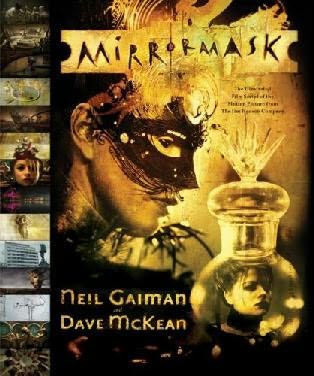
7. MirrorMask


Gaiman, Neil and Dave McKean. MirrorMask. HarperCollins Publishers: New York, 2005.
Annotation: Helena yearns for an ordinary life, one that is far from her circus performing family but when she is jolted into an unfamiliar and magical world she thinks twice about the life she once had.
Justification For Nomination: Cruising through the YA reading I stumbled upon this gem and debated whether it was considered a children's book and was misplaced from the children's section. I checked in with the librarian on duty so I wouldn't mistake the reading and found that was in deed considered teen reading, due to some disturbing images. This made the intrigue for the story and visuals even more appealing to me.
The style the books was written in, reads like a picture book but zig-zags and swirls across the page and around the visual art work presented. Presented through Helena's voice the text comes off slightly angsty yet proper and poetic. Author, Neil Gaiman, proves he is no stranger to bizarre and wonderfully descriptive worlds. "Coraline," one of his earlier works, uses a similar plot of a girl that doesn't quite fit in who is transported to a strange and dangerous world. Both stories intertwine internal and outer conflict resulting with a final decision and showdown with the protagonist and evil force that wants them.
The setting of Mirrormask and the characters were brilliantly and carefully created. Even without the illustrations and visuals my mind was set free to interpret each unique vision to my own hearts desire. Usually the trouble with fantasy is creating an entirely different universe, but both writer Neil Gaiman and illustrator Dave McKean did a phenomenal job getting their visions across.
Mixed with a few still shots and original sketches, the tone of the book really took this simple story to a dark place. Through Helena's journey she is faced with disturbing, vial, creatures and at one point is consumed with darkness. The idea of good/light and bad/dark is played to its advantage in this book and you really see the internal battle between the two.
Another reason this book works so well is the sense of empowerment that Helena takes on. In her old life she is constantly answering to others while in this new one she is her own boss. The new problems she faces in this other reality is the conflict of being replaced in the old one or a sense of abandonment. Similar to "Alice in Wonderland" or "The Wizard of Oz," our protagonist finds the old world more to her liking and reveals the unsuspected horror and race to find a way home.
In the end, MirrorMask is a great run-away, fantasy tale that carries itself with its strong multi-dimensional plot line and twisted imagery. The characters are well written, the style and formatting of the text fits with the madness of every situation and the descriptions are literally out of this world. I highly recommend it to all ages, even the most daring of children.

Sunday, February 15, 2009

3. The Perks Of Being A Wallflower


Chbosky, Stephen. The Perks Of Being A Wallflower. New York: Pocket Books, 1999.

Annotation:
Charlie a passive high school student in the 90's, reveals intimate details and highlights of his life through personal letters written to an anonymous reader.

Justification For Rejection:
Written in a contemporary style, each page consisted of numerous entry dates and a letter format similar to a diary/journal or a "dear John" letter. I thought the different format would be interesting and would make the experience more intimate but unfortunately it came off as a lot of boring babel and pointless sensory details.
If I had to pick a positive thing from this book it would be the 90's atmosphere and all the sensory details. The author also did a good job of capturing the voice of a freshman in high school and the awkward experiences one has with love, sex, puberty and social anxieties. Unfortunately it was too jumbled and scattered within each page to make anything interesting. Each letter seemed like a mini-story that would reveal little or no information that pushed the story forward. It was literally like a journal recalling past events that didn't flow naturally or transition well. Story lines became untangled but it took too long for any sort of hook to present itself. The premise and set up/back story of each character was interesting but the jumping around found it hard to focus.

The author of this book graduated with a film degree and you can definitely tell that he had more experience with films because while the imagery was strong, the story was sort of a mess. This book was similar to reading a screenplay except if it were one it would have had too much voice over and dialogue. The particular letters that re-told actual dialogue or scenes from the protagonist Charlie's past felt particularly UN-natural and pulled you immediately in and out of this persons world like a rag doll.

For the most part, I had the best expectations and enthusiasm for this story and thought it brought up an interesting point of view (first) but the way it was presented and weaved in and out, made it lose it's relevance and interest.


Sunday, January 25, 2009

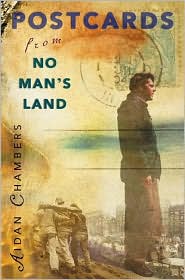
1. Postcards From No Man's Land


Chambers, Aidan. Postcards From No Man's Land. New York: Penguin Group Inc. 1999.
Annotation:
Seventeen year old Jacob, arrives in Amsterdam alone to explore the city, and meet the mysterious Geertrui, a nurse who tended to his dead grandfather during World War II. Once there, he encounters unforgettable experiences that question his ideals of love, sexuality and family.
Justification for Nomination:
Wonderfully blending two separate stories of love and finding yourself, Aidan Chambers manages to interweave these plots together to pack an emotionally devastating, yet satisfying story.
In my first read I'll admit I had a hard time focusing between the two voices the Aidan Chambers uses. For each chapter he bounces back and forth in time to tell a war torn story of two lovers that hold a secret. It isn't until we jump back to the present that we find out what it was and get the rug pulled out from under you.
The style of writing in this book works wonderfully because it packs an emotional punch while also planting and trickling certain details that reveal its importance later on.
I'll be the first to admit that I'm not a fan of war stories but the author does a phenomenal job in painting a picturesque scene without ever over indulging us. As you read on you are actively placed in the shoes of Geertrui, and witness her love struck pain as she mends to hidden soldiers during World War II.
This book is notorious for getting you emotionally involved with the story before it switches to present day setting where we follow an intelligent dreamer named Jacob. Through his adventures you are overtaken with anxiety following him through Amsterdam and getting used to foreign customs and culture.
Both stories really focus on challenging oneself and way of life. It weighs heavily on new experiences and whether or not you let yourself live.
Besides the strong writing style and bouncing in and out of these characters stories, the best part of the book was the strong and realistic dialogue. Since most it all took place in Amsterdam, there were realistic translations and interactions between Jacob (who was English) and the cast he came in contact with. There were many beautiful lines one could pick out that deal heavily with the books theme. Even the slightest phrase sounded so elegant, "all art is love, because all art is about looking closely, isn't it? Looking closely at what's being painted." This is one of my favorite quotes as a character exposes himself while also introducing a particular philosophy.
In the end I found this book very moving, coming of age and filled with honest emotion. As a screenwriter I found the story visually breathtaking and could easily translate to film and touch others lives as much as it has mine.